


Report on the NECE Lab “AI and the Future of Historical Learning” (Salzburg, September 16 – 18, 2026)
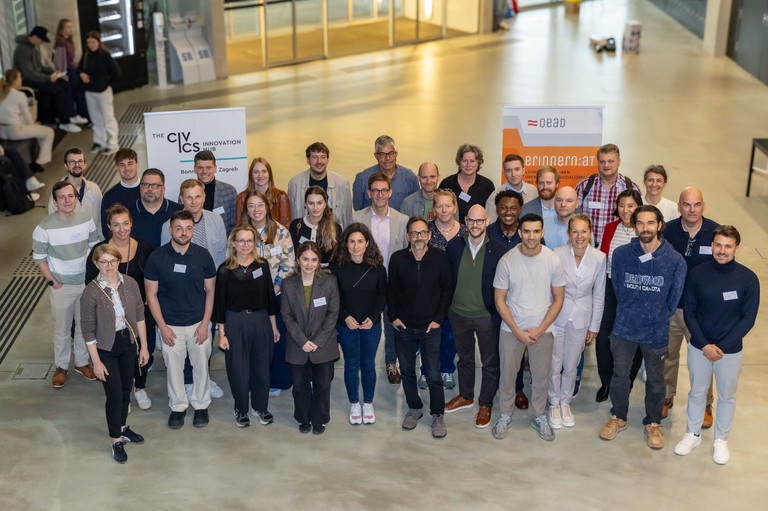
From September 16 to 18, 2026 the NECE Lab “AI and the Future of Historical Learning” took place at the University of Salzburg’s Unipark Nonntal. It was organised by THE CIVICS Innovation Hub in collaboration with the OeAD program ERINNERN:AT and the Department of History at the University of Salzburg. NECE (Networking European Civic Education) is funded by the German Federal Agency for Civic Education (bpb). Approximately 40 participants from universities, schools, museums, foundations and civil society organisations across several European countries took part. Over the course of three days, they explored how artificial intelligence is transforming the study, teaching and remembrance of history. Patrick Siegele, Head of the Holocaust Education Division at the OeAD, led the program. The lab was divided into three “arenas”: „Encountering AI“, „The Historical Consciousness of AI“ and „AI as a Site of Ethical and Moral Conflict“.
Opening remarks
Anja Ostermann (Managing Partner, THE CIVICS Innovation Hub) introduced THE CIVICS as a pan-european non-governmental organisation and used a map to highlight the networks partner organisations. Martin Knoll, Dean of the Faculty of Social Sciences (University of Salzburg), spoke in his opening remarks about the current challenges surrounding AI. He noted that the field of history often moves too slowly in this debate, but that risks and potential are becoming apparent, especially now. He highlighted the conference’s interdisciplinary approach. Patrick Siegele emphasized that AI is playing an increasingly important role in all areas of ERINNERN:ATs work.

The organizing team, from left to right: Patrick Siegele (OeAD ERINNERN:AT), Anja Ostermann (The CIVICS Innovation Hub), Kwadwo Fidelis Nketia (The CIVICS Innovation Hub), Christoph Kühberger (University of Salzburg); not pictured: Robert Obermair (University of Salzburg) © OeAD APA-Fotoservice Franz Neumayr
Keynote: “Does AI Introduce a New Paradigm for Holocaust Memory?“
Victoria Grace Richardson-Walden (University of Sussex, Director of the Landecker Digital Memory Lab) described the goal of her work: to ensure the long-term preservation of Holocaust remembrance in the digital age. Remembrance work does not have to be digital, she said, but we must acknowledge that we live in a digital age. One of her core arguments was that AI is neither a single technology nor a simulation of human intelligence. There are a multitude of models; therefore, instead of “AI is,” we should say “AI are.” She advocated for a critical middle ground between AI hype and AI dystopia. As an example of the tension between authenticity and artificiality, she cited an open letter from the Dachau Concentration Camp Memorial Site dated January 2026 opposing AI-generated content. The letter expressed concern that AI undermines the credibility of museums. At the same time, in a survey of 120 Holocaust memorial institutions, the majority reported that they were already using AI.
While memorial institutions have little influence over the major AI companies, they do have influence over their own practices. Richardson-Walden advised against establishing hierarchies of authority, suggesting instead that learners and visitors be asked where they find their information and that they be helped to develop skills in historical inquiry. Educational programs should meet people where they are.
The Need for Historical and Civic Education: The Case of Bulgaria
In the second presentation of the day, Denitza Vidolova (Sofia Platform Foundation) provided insight into the organisation - which has been in existence for 13 years - and the current challenges it faces in its work in Bulgaria. She noted that political and historical education is marginalized: civic education is only taught in the last two years of school, and teachers are not trained for it. Communism has only been part of the curriculum since 2019/20. This is getting more important given that more and more students want to understand the past of their parents and grandparents without having experienced communism themselves. Added to this are ongoing political instability, polarization, and a lack of digital skills. It is also becoming increasingly difficult for civil society organisations to collaborate with schools. There is no museum dedicated to the communist era. The Sofia Platform is attempting to fill these gaps and, as a civil society organisation, is establishing a digital memorial to the Belene forced labor camp (1949–1987).
The following discussion focused on the unequal representation of the Holocaust and communism. There are hardly any images of the Belene camp, and many files have been destroyed. AI could make digitized archives accessible, but it could also generate stereotypical images. Richardson-Walden noted that AI brings to light problems that already existed. The discussion also addressed why ethical questions about AI are raised primarily in connection with the Holocaust, but rarely in relation to other historical periods.
The first day concluded with a historical scavenger hunt through Salzburg, organised by Robert Obermair (Public History, University of Salzburg), during which participants – divided into small, randomly formed groups – had the opportunity to get to know one another and explore the Old Town. The destination was the Pauli Stubm restaurant, where the day came to a close with a group dinner.
Arena 1: Encountering AI
The second day began with a keynote address by Claudia Müller-Birn (Head of the Human-Centered Computing Research Group, Freie Universität Berlin). The widespread assumption that humans and AI are more effective when working together than when acting independently has not been confirmed by research. While humans do work better with AI, they do not perform better than AI alone. Those with high self-confidence make better use of AI. Using examples, she demonstrated how little transparency remains in language models. Even when a model describes its solution process, that does not necessarily correspond to what it actually did. Two of her findings were particularly insightful for historical education. The same question can lead to a different narrative depending on the language and national context. And AI can summarize testimony without “listening” to it: it reproduces content but does not interpret it.

Claudia Müller-Birn (Free University Berlin) during her key note: How does AI ‘think’? - reasoning and large language models: what can AI actually do and what can it not do? © OeAD APA-Fotoservice Franz Neumayr
Christoph Kühberger (Professor of History Education and Civic Education, University of Salzburg) spoke about metacognition – that is the reflection, monitoring, and control of one’s own thinking and learning. Studies have shown that high levels of trust in generative AI are associated with less critical thinking, while high self-confidence is associated with more. AI creates a false sense of certainty. Nevertheless, it will be part of everyday school life. The real question, therefore, is what should not be done with AI in history classes, since a machine cannot create anything new or interpret information.

In Breakout-Sessions the participants discussed the implication of AI for schools, museums, memorial sites and communities. © OeAD APA-Fotoservice Franz Neumayr
The topics were explored in greater depth during three breakout sessions. As Sabrina Schmitz-Zerres was unable to attend due to illness, Christoph Kühberger took over the breakout room on schools. The group reflected on the use of AI in schools and discussed its benefits, obstacles and challenges. The overall attitude towards AI was not negative, but participants agreed that teaching and learning would need to be adapted accordingly. Drawing on their own experience, they related the arguments from the morning keynotes to their specific situations. Florian Tuder (House of European History, Brussels) presented “HistoriCall,” a free learning platform available in 24 EU languages. It is aimed at 12- to 18-year-olds, uses quizzes, case studies, and AI-supported introductory videos, and offers lesson plans to teachers. When analyzing photos and quotes that were partially or entirely generated by AI, even the experts in attendance often struggled to distinguish the real from the fake. Denitza Vidolova presented the interview platform on Belene. Using oral history methods, survivors were asked approximately 600 questions; the algorithm matches user questions to these. The challenges facing the project and the interviewees were discussed. The project team found that some users treated the platform like an avatar and asked questions without any context.

Florian Tuder explains how AI is used in the House of European History in Brussels. © OeAD APA-Fotoservice Franz Neumayr
Arena 2: The Historical Consciousness of AI
Heinrich Ammerer (University of Salzburg) addressed AI-generated images and the issues they raise: oversimplification, emotionalization, personalization, and unverified details. He cited the debate surrounding Google Gemini 2024 as an example. Mykola Makhortykh (University of Bern) explained why the question “How does AI work?” is difficult to answer. There is no single AI, but rather many (“there are AIs”). One can examine individual systems through audits or gain an overview of their basic principles. AI is based on probabilities, and training follows the principle of “garbage in, garbage out”: if the training data is incomplete or one-sided, the model reproduces these biases.
In the afternoon, three groups led by Robert Obermair (University of Salzburg), Judith Blum (EVZ Foundation), and Drew Thomas (University of Salzburg) explored the day’s topics in greater depth and presented their findings to the plenary. The first group compiled examples of how AI is already being used in everyday professional life: to create assignments and worksheets, for research and summaries, as a “devil’s advocate,” to translate and simplify texts, or for programming. For schools, the group identified efficiency gains and new methods on the one hand, and bad habits and dependence on AI on the other. The second group sought a middle ground between AI hype and AI dystopia. They pointed to the power held by a few companies in two countries and asked who is most likely to become “trapped” in AI-generated content and how assignments should be designed in the future – for example, in a more practical and source-based manner. Critical thinking must be taught by educators, which in turn depends on the political situation in each country. The third group focused on teachers. They said teachers need clarity and guidelines on the role of AI, professional development, networking, and a voice in political decisions – rather than simply implementing directives “from above.” Anyone who creates a worksheet using AI should disclose that fact. And it is important to ask what AI is actually replacing and what tasks we want it to perform.
Arena 3: AI as a Site of Ethical and Moral Conflict
The third day began with a summary of the previous day’s events by Patrick Siegele, followed by three brief presentations. Robert Breber (Cuts & Mouse) discussed the ORF documentary “Hachschara,” in which, according to ORF, generative AI was used on a large scale for the first time in an Austrian documentary. Because there was hardly any well-preserved footage available, real photographs were animated into moving images using AI and then blurred. Breber referred to this as a “digital reenactment”: the video was generated, not the event. At the time, there were no guidelines in place; today, such material must be labeled as such.
Robert Schäfer (University of Basel) and Nicolas Python (ePost), joining online from Switzerland, presented a chat tool. It simulates dialogues with more than 580 supporters of National Socialism based on first-person accounts from 1934 preserved in the Hoover Archives. In these accounts, the men recount the First World War, the interwar period, and their family lives. A scholarly context can be accessed for each response. There was also discussion about the extent to which colourisation collapses historical distance. Access will remain password-protected. The target audiences are schools and museums. The project team hopes to raise awareness of radicalization processes, including those occurring today.
To conclude, Denitza Vidolova presented a virtual tour of Belene, which is now home to a prison and therefore has restricted access.

Participants reflection on the inputs during coffee break. © OeAD APA-Fotoservice Franz Neumayr
Between Dystopia and Utopia
In the exercise “Letters from 2036,” the participants devised future scenarios. Ideas included avatars and digital personas in classrooms, changes to university operations, the question of whether museums would still exist, and greater national differences than today. A “rebellion” in the form of a digital detox in schools was also explored. A second poster outlined what, from the perspective of 2036, might have gone right or wrong. On the positive side were the role of teachers, multiperspectivity and curiosity about history. On the negative side was the uncritical use of AI in the classroom, which “makes people lazy”. The participants recommended including students in the conversation about the use of AI, training human experts well, ensuring that governments stay up to date, and introducing stricter rules for AI-generated content, including on social media.
In the final round, the groups compiled dystopian and utopian scenarios. On the dystopian side were job losses, the removal of the human touch, fake imagery and an “oligarchy of knowledge.” On the utopian side were teachers becoming more important, better-tailored learning opportunities, and more dialogue with learners about AI. On a scale of 0 to 10, two groups rated themselves at 6, while the third group’s rating fluctuated but tended toward the positive. In addition, the participants called for clear guidelines and regulation, a shared vocabulary for discussing AI, and more civic education.
Anja Ostermann concluded by thanking Robert Obermair, Patrick Siegele, and Christoph Kühberger.